 Aiyana Greyhorse 13 min read
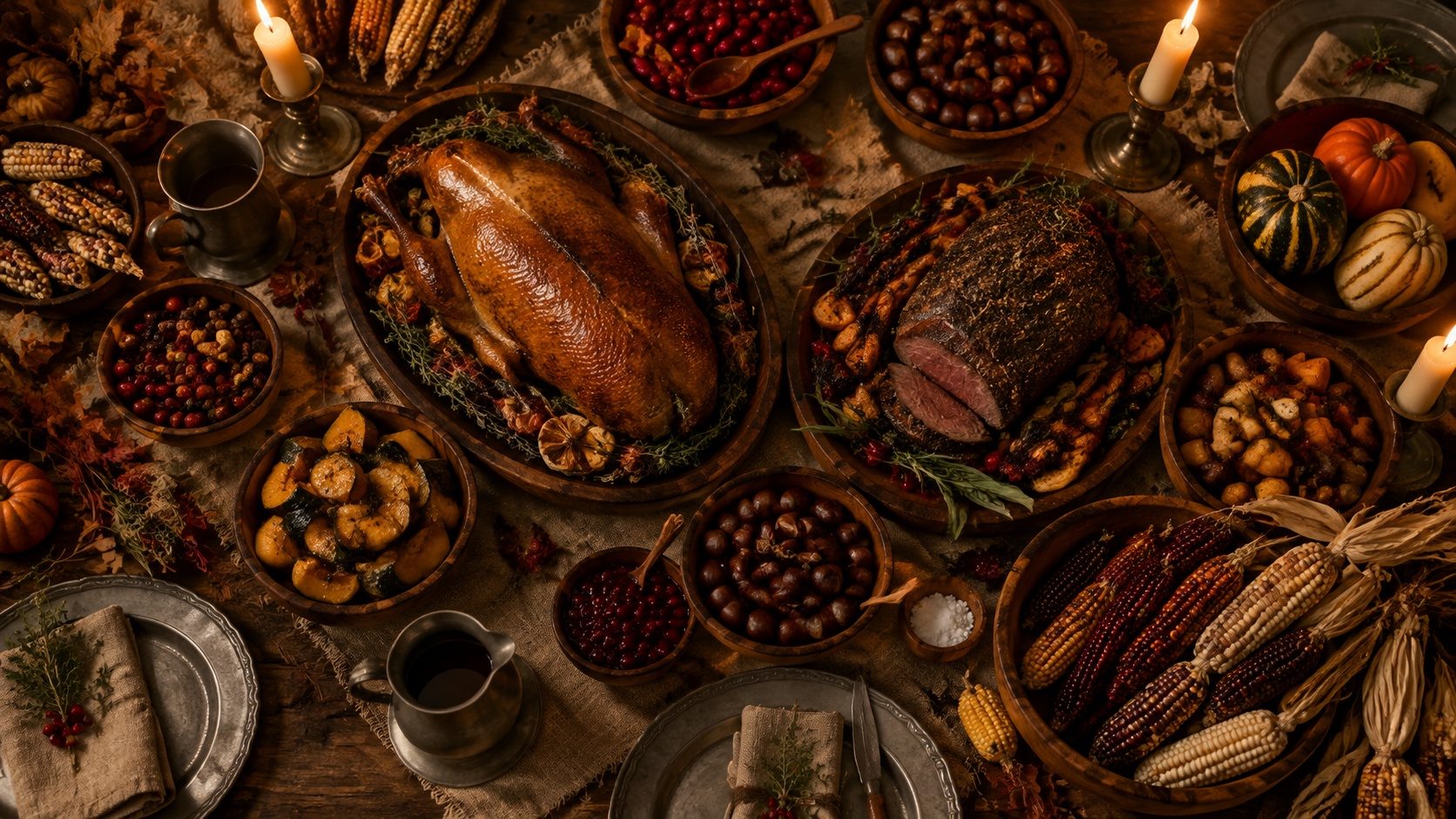
Happy Thanksgiving. Today, Thursday 26 November 2026, falls on a date with a quiet echo: George Washington's first national day of thanksgiving was also a Thursday the 26th of November, in 1789. Almost everything else about the holiday, however, is less tidy than the version most of us learned in school. The famous feast was not called a thanksgiving by the people who held it. It was not the first. The guests outnumbered the hosts. And the date we keep today was only fixed in law nineteen days after Pearl Harbor.
This is a history of the holiday built from the surviving documents and from the museums and archives that look after them. Where historians disagree, or where the record simply runs out, we say so. Every source is linked at the end.
Short version: The 1621 gathering at Plymouth was a three-day harvest celebration attended by about ninety Wampanoag men and roughly fifty English colonists. The only eyewitness account names two foods, wildfowl and venison. The national holiday came 242 years later, after a magazine editor's long letter-writing campaign reached Abraham Lincoln in the middle of the Civil War.
Key takeaways
- One short paragraph is nearly all we have. The 1621 celebration is described first-hand in a single letter by Edward Winslow, with a second brief mention by William Bradford. Much of what is painted on greeting cards comes from the nineteenth century, not the seventeenth.
- The colonists would not have called it a thanksgiving. To them a day of thanksgiving meant prayer and fasting. Plymouth's first event of that kind is recorded in 1623.
- Several earlier gatherings have a claim to "first". Florida in 1565, the Canadian Arctic in 1578, the Rio Grande in 1598 and Virginia in 1619 all come before Plymouth, and Indigenous harvest ceremonies are older than all of them.
- A persistent editor made it national. Sarah Josepha Hale wrote to Lincoln on 28 September 1863. His proclamation followed on 3 October.
- The date was a political fight. Franklin Roosevelt moved the holiday a week earlier in 1939 to lengthen the shopping season. Congress settled it on the fourth Thursday in a law signed on 26 December 1941.
What the eyewitness actually wrote
In the autumn of 1621 the English settlers at Plymouth brought in their first harvest. About half of the 102 people who had crossed on the Mayflower had died during the previous winter, so the community that sat down to celebrate numbered roughly fifty. Edward Winslow described what happened next in a letter printed in London in 1622, in the book known as Mourt's Relation:
"Our harvest being gotten in, our governor sent four men on fowling, that so we might after a special manner rejoice together after we had gathered the fruit of our labors. They four in one day killed as much fowl as, with a little help beside, served the company almost a week. At which time, amongst other recreations, we exercised our arms, many of the Indians coming amongst us, and among the rest their greatest king Massasoit, with some ninety men, whom for three days we entertained and feasted, and they went out and killed five deer, which they brought to the plantation…"
That is essentially the whole record. From it we know three things with confidence. The celebration ran for at least three days. The Wampanoag party led by Ousamequin, whom the English called Massasoit, was about ninety strong, so Native guests outnumbered the English by nearly two to one. And the Wampanoag supplied a large share of the meat, in the form of five deer. Venison mattered: as Plimoth Patuxet Museums notes, it was a food that ordinary English people rarely tasted at home.
What the letter does not say is equally important. It does not call the event a thanksgiving, does not record an invitation, and does not mention prayers, although prayer would have been part of daily life. The Smithsonian's National Museum of the American Indian places the gathering in the context of a mutual-protection treaty agreed in the spring of 1621 between Ousamequin and the colony's governor. Seen that way, the three days look less like a dinner party and more like diplomacy between uneasy allies.
Why they would not have called it "Thanksgiving"
For the Plymouth colonists, a day of thanksgiving was a religious observance, declared in response to a specific mercy and spent largely in worship. Games, shooting displays and three days of feasting belonged to a different English tradition, the harvest home. The first event at Plymouth that William Bradford himself describes as a day of thanksgiving came in 1623, after rain rescued a failing crop. The label "First Thanksgiving" was attached to 1621 more than two centuries later, when Winslow's letter was rediscovered and reprinted in the 1840s.
What was on the table, and what was not
Food historians work from Winslow's letter, Bradford's account, archaeology and period cookbooks. Kathleen Wall, a foodways culinarian at Plimoth Patuxet, told Smithsonian Magazine that only three things are "absolutes": wildfowl, corn and venison. The rest is informed inference.
| Food | Was it there? | Why we think so |
|---|---|---|
| Venison | Yes | Winslow records five deer brought by the Wampanoag |
| Wildfowl (ducks, geese, possibly turkey) | Yes | Four men "on fowling" supplied the company for almost a week. Turkey is plausible but not named in the letter |
| Corn, as bread or porridge | Yes | It was the harvest being celebrated |
| Shellfish and fish | Likely | Abundant on the coast and a staple for both peoples |
| Squash, beans, nuts | Likely | Standard Wampanoag crops and gathered foods in season |
| Potatoes, mashed or sweet | No | Neither had reached New England by 1621 |
| Pumpkin or apple pie | No | No butter or wheat flour for pastry, and no ovens for baking |
| Cranberry sauce | No | It needs sugar, which the colony barely had |
In other words, the centrepiece of the meal was probably deer, the bird may not have been a turkey, and the dessert course did not exist. The modern menu took shape in the nineteenth century, when cookbooks and magazines were busy inventing an idealised New England past.
Who gave thanks first? The earlier claims
Plymouth has the best-known story, but several places have documents showing Europeans holding thanksgiving observances on North American soil earlier, and each has its champions.
| Year | Place | What happened |
|---|---|---|
| 1565 | St. Augustine, Florida | Pedro Menéndez de Avilés and about 800 Spanish settlers celebrated a Mass of Thanksgiving on landing on 8 September, then shared a meal with the Seloy people who lived there. The National Park Service suggests the dish was probably cocido, a pork and chickpea stew |
| 1578 | Frobisher Bay, in today’s Nunavut | Martin Frobisher’s expedition gave thanks for the safety of its fleet, an event Canada counts as its first Thanksgiving |
| 1598 | Near San Elizario, Texas | Juan de Oñate’s expedition, after crossing the Chihuahuan Desert, held a feast and a Mass of thanksgiving on the banks of the Rio Grande |
| 1619 | Berkeley Hundred, Virginia | English settlers arriving on 4 December were instructed by their charter to keep the day of their landing "yearly and perpetually" as a day of thanksgiving |
| 1621 | Plymouth, Massachusetts | The three-day harvest celebration with the Wampanoag |
Which of these was "first" depends on what you are counting: a religious service, a shared meal, an annual custom or the ancestor of the present holiday. What is not in dispute is that giving thanks for a harvest was already ancient on the continent. As the Smithsonian's study guide on the harvest ceremony puts it, Native peoples "have always given thanks for the world around them". The Wampanoag and their neighbours marked the seasons with ceremonies of gratitude long before any ship arrived.
The editor who would not give up
For two centuries after Plymouth, thanksgiving days were local affairs, proclaimed by colonies and then by state governors on dates of their own choosing. George Washington proclaimed a national day in 1789, but the practice did not stick. The person who changed that was Sarah Josepha Hale, the editor of Godey's Lady's Book, one of the most widely read magazines in the country, and the author of the nursery rhyme "Mary's Lamb", better known as "Mary Had a Little Lamb".
Hale campaigned for a single national Thanksgiving for years, by most accounts from 1846, through editorials and personal letters to governors and to one president after another. On 28 September 1863 she wrote to Abraham Lincoln, introducing herself as "Editress of the Lady's Book" and asking him to make the day "a National and fixed Union Festival". Five days later, on 3 October 1863, Lincoln issued a proclamation setting apart the last Thursday of November. According to the American Battlefield Trust, the text was actually drafted by Secretary of State William Seward.
The timing is easy to forget. The proclamation came three months after Gettysburg, in the bloodiest year of the Civil War. It asks Americans to give thanks while also remembering "all those who have become widows, orphans, mourners or sufferers", and to pray for the healing of "the wounds of the nation". The modern holiday was born as an appeal for unity in a divided country.
"Franksgiving": the year America had two Thanksgivings
Lincoln's last-Thursday custom held for three-quarters of a century, by presidential proclamation each year rather than by law. Then came November 1939, a month with five Thursdays. The last one fell on the 30th, leaving an unusually short gap before Christmas. Retailers had been lobbying for an earlier date since 1933, and on 14 August 1939 Franklin Roosevelt announced that he would proclaim Thanksgiving for 23 November instead.
The reaction was immediate. Calendars were already printed, football schedules were set and many people simply objected to tampering with tradition. The National Archives account records that more than half the governors set different dates, and critics named the new holiday "Franksgiving". For two years families could find themselves celebrating on different Thursdays depending on which side of a state line they lived on. In 1940, according to the U.S. House historian, sixteen states refused to follow the president.
Congress ended the confusion. The House passed a resolution on 6 October 1941 fixing the last Thursday, the Senate amended it to the fourth Thursday to deal with five-Thursday Novembers, and Roosevelt signed it on 26 December 1941. Thanksgiving has been the fourth Thursday of November ever since.
In all, 320 years passed between the harvest of 1621 and a legally fixed Thanksgiving Day.
Thanksgiving beyond the United States
The fourth Thursday of November is one of several days of thanks on the world's calendar. Some grew from the American holiday, some from older harvest festivals and some from entirely separate histories.
| Country | When | Where it comes from |
|---|---|---|
| Canada | Second Monday of October | Traced to Frobisher’s 1578 ceremony; Loyalists arriving after the American Revolution brought turkey and other customs north |
| Liberia | First Thursday of November | Carried by formerly enslaved and free Black Americans who settled there in the nineteenth century |
| Grenada | 25 October | Marks the anniversary of the 1983 intervention on the island |
| Japan | 23 November | Labor Thanksgiving Day, which grew out of an ancient autumn rice-harvest ritual and now honours workers |
| Germany | Usually early October | Erntedankfest, a church harvest festival with processions and decorated altars rather than a family dinner |
| Norfolk Island | Last Wednesday of November | Introduced by visiting American whaling ships |
The other gathering in Plymouth
A full history has to include what the holiday means to many Native Americans. In 1970, Massachusetts marked the 350th anniversary of the Mayflower landing and invited Frank James, an Aquinnah Wampanoag man also known as Wamsutta, to speak. He wrote a speech drawing on the colonists' own writings to describe what followed 1621: epidemics, the loss of land and, within two generations, a devastating war. The organisers asked to see the text in advance and would not allow it to be delivered as written.
James declined to give a revised version. Instead, on Thanksgiving Day 1970 he and supporters gathered on Cole's Hill, overlooking Plymouth Rock, for the first National Day of Mourning. It has been held there at noon every Thanksgiving since. As Pilgrim Hall Museum in Plymouth explains, for many Indigenous people the day is a reminder of loss as well as survival. Knowing this does not cancel anyone's gratitude. It simply makes the story whole, and the Wampanoag are still here, in the same homeland, to tell their part of it.
Eight things most people don't know
- The guests outnumbered the hosts. About ninety Wampanoag men joined roughly fifty English colonists.
- It lasted three days, and included what Winslow called "recreations" and a display of arms, not just a meal.
- Turkey is unconfirmed. The letter says "fowl". Ducks and geese are at least as likely.
- There were no forks. Table forks were not in common English use in 1621. People ate with knives, spoons and fingers.
- The author of "Mary Had a Little Lamb" is the reason it is a national holiday.
- Lincoln did not write his famous proclamation. William Seward drafted it.
- For two years the country could not agree on the date, and some Americans celebrated a week apart from their neighbours.
- The law fixing the date was signed nineteen days after Pearl Harbor.
Frequently asked questions
When was the first Thanksgiving?
The celebration usually given that name took place at Plymouth in the autumn of 1621, probably between late September and early November. The exact dates were not recorded. Earlier thanksgiving observances by Europeans are documented in Florida in 1565, the Canadian Arctic in 1578, Texas in 1598 and Virginia in 1619.
Did the Pilgrims invite the Wampanoag?
The surviving account does not say. Winslow writes only that "many of the Indians" came "amongst us". Some historians think the Wampanoag arrived after hearing gunfire from the colonists' shooting display; others read the visit as a planned diplomatic call under the treaty agreed that spring. The record does not settle it.
Why is Thanksgiving on a Thursday?
Thursday was a customary day for religious lectures and for days of fasting and thanksgiving in colonial New England, comfortably distant from the Sunday sabbath. Washington chose a Thursday in 1789, Lincoln followed in 1863, and Congress made it the fourth Thursday of November in 1941.
Is Thanksgiving a religious holiday?
Its roots are religious, and many families begin the meal with a prayer, but in law it is a civic holiday. The 1941 statute simply names the fourth Thursday of November "Thanksgiving Day" and makes it a legal public holiday.
A closing thought
The real history of Thanksgiving is more complicated than the picture-book version, and more human. It contains hunger and generosity, diplomacy and grief, a stubborn editor, a wartime president and a long argument about a calendar. What has survived all of it is the simple act at the centre: stopping, sitting down with other people and saying thank you for what there is.
Wherever you are today, whoever is at your table and whatever is on it, we wish you warmth, safety and good company. Happy Thanksgiving, and may this be blessed for all.
Sources
- Smithsonian Magazine — What Food Was Served at the First Thanksgiving in 1621? (updated Nov 2024)
- Plimoth Patuxet Museums — What did they eat at the 1621 harvest celebration?
- Smithsonian National Museum of the American Indian — Treaty and Harvest Celebration
- Smithsonian National Museum of the American Indian — Harvest Ceremony: Beyond the Thanksgiving Myth (study guide)
- Historical Digression — What did They Eat during the "First Thanksgiving"? (on the 1623 day of thanksgiving)
- National Park Service, Castillo de San Marcos — The First Thanksgiving (St. Augustine, 1565)
- NPR — Was the first "Thanksgiving" feast actually along the Rio Grande? (Nov 2025)
- Library of Congress — The Real History of Thanksgiving (Nov 2024)
- HISTORY — 8 Thanksgiving Celebrations Around the World
- Library of Congress — Sarah J. Hale to Abraham Lincoln, 28 September 1863 (transcription)
- American Battlefield Trust — Abraham Lincoln’s Proclamation of Thanksgiving
- National Park Service, Lincoln Home — Lincoln and Thanksgiving
- National Archives Museum — President Abraham Lincoln’s Thanksgiving Day Proclamation
- National Archives, Prologue — Thanksgiving: Another FDR Experiment
- U.S. House of Representatives, History, Art & Archives — Thanksgiving Holiday Bill (H.J. Res. 41, 1941)
- GovInfo — Thanksgiving: establishing the holiday
- Voice of America — Other Countries that Celebrate Thanksgiving
- Quartz — Thanksgiving around the world: how 10 places mark a day of thanks (Nov 2026)
- Pilgrim Hall Museum — National Day of Mourning
- Facing History & Ourselves — Disrupting Public Memory: The Story of the National Day of Mourning
From our own rounds
Measured on The Curator, from real sessions people played on this site — not a third-party dataset.
- Rounds played here
- 289
- Questions per round
- 1.7
Most-played topics right now: Product Validation (1).
Play a round and add to these numbersSubscribe to The Curator updates
New articles, site messages and notifications — straight to your inbox. Unsubscribe anytime and your details are deleted.
Rate this article
Discussion
Comments are moderated. Read our editorial policy.